
No—a bill of sale alone is generally not enough to complete a typical private-party car sale involving a titled vehicle; you also need the ownership-transfer documents required by the relevant state. In 2026, treat the bill of sale as evidence of the transaction, not a replacement for a properly assigned title, lien release, or required motor vehicle agency filings.
- Is a bill of sale enough to sell a car? Generally no: a titled vehicle needs proper title-transfer paperwork.
- A bill of sale records the transaction; a certificate of title documents ownership.
- Resolve missing titles and recorded liens before completing the handoff.
- Zendocs supports online document editing and signing, not government approval of a vehicle transfer.
Is a bill of sale enough to sell a car?
For a titled car, the bill of sale usually supports the transfer rather than completing it. The buyer needs the documents the state accepts for transferring ownership and obtaining registration. A receipt signed by both parties does not automatically satisfy those requirements.
Start with your state's motor vehicle agency instructions, then choose a form that matches them. A guide to online bill of sale templates for vehicles can help with document selection, but the state's instructions determine what you must submit.
| Document | Best for | What it establishes | What it does not establish alone |
|---|---|---|---|
| Bill of sale | Recording transaction terms | The parties' written record of the vehicle sale | Completion of the state's ownership-transfer process |
| Assigned certificate of title | Transferring a titled vehicle | The seller's assignment of the ownership document | Completion of every registration or reporting requirement |
| Lien release | Resolving a recorded lender interest | Documentation that a particular lien has been released | Transfer of ownership to the buyer |
| Registration certificate | Identifying the registered vehicle | The vehicle's registration information | A universal substitute for a title |
A bill of sale can matter in a dispute even when it is insufficient for a title application. Those are separate questions: does the document record your agreement, and does the state accept your transfer paperwork? Answer both before handing over the car.
Why this matters
A buyer can hold a signed bill of sale and the keys yet still lack the paperwork needed to title or register the car. A seller can hand over possession without completing a required sale notice or release-of-liability filing.
Your 2026 sale checklist should therefore cover more than a receipt. Confirm ownership, satisfy transfer requirements, and preserve a clear record of the handoff. This page provides general information, not legal advice for a particular transaction or state.
When the seller has a clear title
A clear title is the starting point, not the final step. Check that the seller's identity matches the ownership document and that every required owner can sign. Follow the title's instructions rather than signing wherever there appears to be space.
Before completing the transaction:
- Compare the vehicle identification number on the car with the title and bill of sale.
- Check whether the title identifies joint owners or a lienholder.
- Complete the assignment fields, odometer disclosure, and signatures required for that vehicle.
- Check whether separate sale, inspection, emissions, or registration documents apply.
- Confirm how the seller reports the sale and how the buyer applies for ownership transfer.
Do not accept a blank buyer field as a shortcut. The paperwork should identify the actual parties to the transaction. An incomplete or incorrectly assigned title can create problems that a separate bill of sale does not fix.
When the title is missing
A missing title calls for the state's replacement or alternative-ownership process—not a more elaborate receipt. The titled owner should check the replacement-title procedure before promising that a bill of sale will be sufficient.
Lost paperwork is different from a seller who never obtained title in their own name. In the latter situation, establish who can legally transfer the vehicle and what documents the state requires to correct the ownership record.
For a buyer, the practical question is simple: what exact documents will the motor vehicle agency accept for this vehicle? Get that answer before completing the purchase rather than relying on the seller's assurance that registration will be straightforward.
When the vehicle has a loan or recorded lien
A seller's signature does not release a lender's recorded interest. If the title shows a lien, confirm the lender's process for releasing it and delivering the ownership documents.
Arrange the transaction around that process. Ask who holds the title, what release evidence the buyer receives, and how the buyer completes the transfer after the lender's requirements are satisfied.
A bill of sale is not proof that a lien has been released. Keep the transaction record and the lien-release evidence together, but treat them as documents serving different purposes. Do not assume a statement in the receipt changes the lender's rights.
When the car qualifies for a title exemption
Some states have title exemptions or alternative documentation rules for certain vehicles. Eligibility depends on the jurisdiction and vehicle category; an older car is not automatically exempt everywhere.
Confirm the applicable 2026 rules with the motor vehicle agency that will process the buyer's application. Ask whether it requires prior registration, a particular bill of sale, an inspection, or other ownership evidence.
An exemption from a title requirement is not an exemption from every transfer requirement. Use the state's accepted document combination, not a generic claim that older cars only need a bill of sale. Cross-state purchases deserve particular attention because the receiving state decides what it accepts.
Why car-sale paperwork varies
The required documents depend on the transaction, not just the form you download. Check these factors before choosing or signing a bill of sale:
- State jurisdiction: The buyer's title application and the seller's reporting obligations can involve different agencies.
- Title status: A missing, electronic, damaged, or incorrectly assigned title requires the corresponding procedure.
- Recorded liens: A lender's interest adds release documentation and coordination.
- Vehicle eligibility: Title exemptions and special vehicle categories change the required evidence.
- Ownership circumstances: Joint ownership, estates, and authorized representatives require appropriate signatures or authority.
- Transaction requirements: Odometer disclosures, notarization, inspections, and emissions requirements depend on the applicable rules.
Do not use a checklist from an unrelated state as your filing instructions. For a 2026 transaction, check the current official requirements for the vehicle and the buyer's application location.
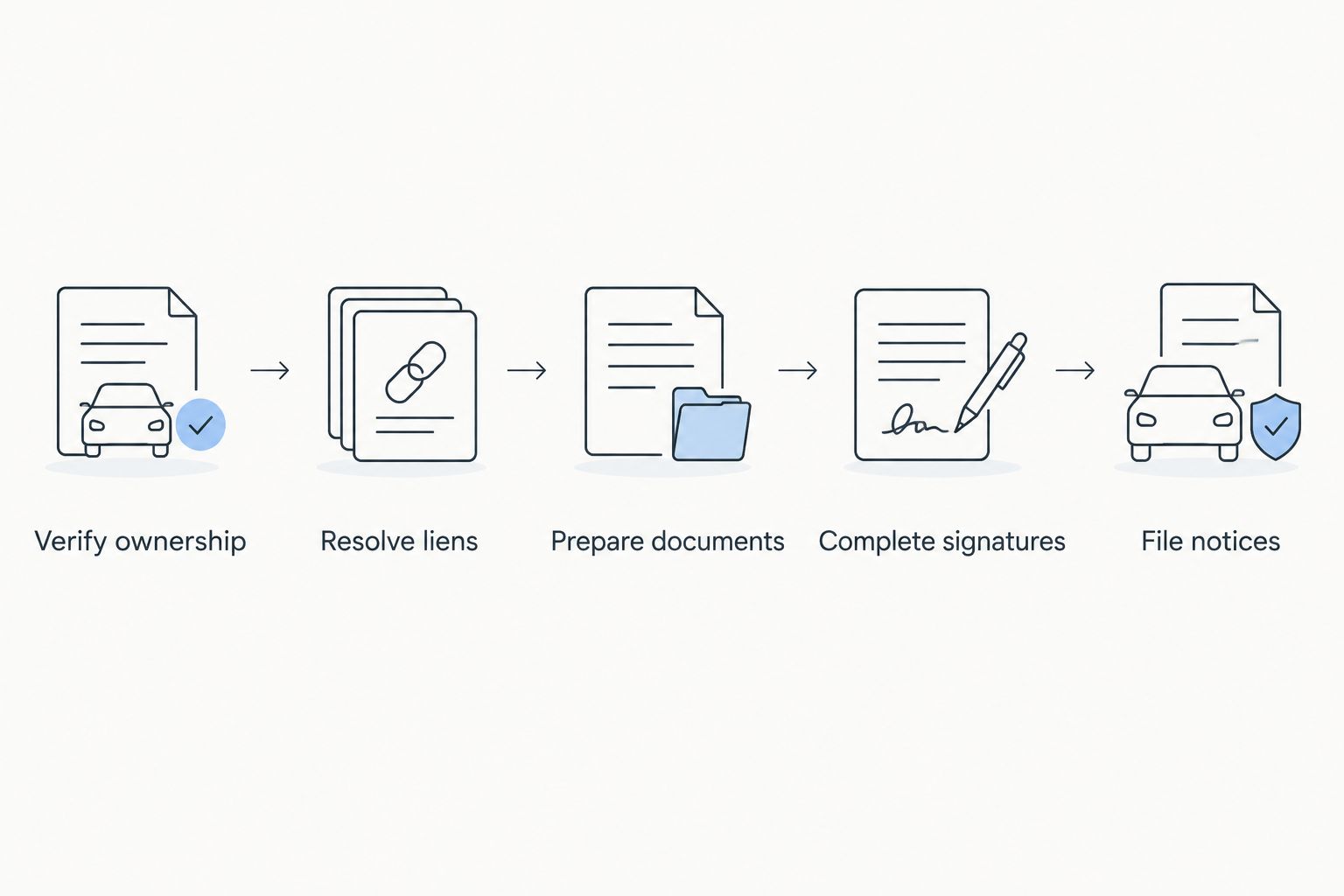
How do you complete a private car sale properly?
Use this sequence to organize the paperwork. It does not replace the state's instructions; it helps you identify an unresolved requirement before possession changes hands.
- Verify ownership. Match the seller's identity to the title or other accepted ownership evidence. Check that the vehicle identification number matches the car.
- Resolve liens. Establish whether a lender has a recorded interest and obtain its instructions for releasing that interest.
- Prepare documents. Gather the correct title assignment, transaction record, disclosures, and supporting forms before the meeting.
- Complete signatures. Follow the required signing method, including notarization where applicable. Review every completed field before accepting the documents.
- File notices. Complete the seller's required reporting and the buyer's title and registration applications. Confirm what documents each party must retain.
The order matters: discovering a missing owner signature after the handoff is harder to resolve than checking it beforehand. Keep the transfer documents together so that neither party mistakes a signed receipt for a completed application.
What should you check on the bill of sale?
Use the official form when the state requires one. Otherwise, make sure the transaction record clearly identifies the parties, vehicle, sale date, agreed terms, and signatures required for your situation.
For modern passenger vehicles, the VIN has 17 characters. Compare the full identifier against the vehicle and ownership document rather than matching only the ending characters; older vehicles can use different identification formats.
As a practical recordkeeping step, retain 2 copies of the completed bill of sale: one for the buyer and one for the seller. That recommendation does not replace any original-document submission requirement. Keep signed originals wherever the agency requires them.
Before signing, perform 3 checks: identity, vehicle details, and document completeness. An accurate receipt is useful evidence; an accurate receipt paired with incomplete transfer paperwork still leaves the transfer unfinished.
Can you prepare the documents online?
Zendocs is suited to individuals and businesses that need browser-based PDF editing and signing. You can use Zendocs to work with document files while organizing the transaction paperwork.
The benefit of an online document tool is practical: you can prepare readable fields and manage the resulting files. The limitation is equally important: document software does not establish ownership, release a lien, or decide whether an agency accepts an electronic signature.
Use Zendocs for PDF document preparation only where that workflow fits the required form and signing method. If the state requires an original title, a particular signature process, or notarization, follow that requirement rather than substituting a digitally completed copy.
Can you sell a car with just a bill of sale and no title?
Generally, no—not through the ordinary transfer process for a vehicle that requires a title. A bill of sale alone does not replace the missing ownership document.
Check whether the titled owner must obtain a replacement or whether a specific state procedure applies. A title exemption or approved alternative process must actually cover the vehicle; the seller's promise is not enough.
Does notarizing a bill of sale make it enough?
No—notarizing a bill of sale does not turn it into a certificate of title or complete the state's transfer process. Notarization serves its specified witnessing or acknowledgment purpose; it does not supply missing ownership evidence.
Use a notary when the applicable instructions require one. Do not treat the notary's involvement as a substitute for checking the title, lien status, or required filings.
Does an as-is bill of sale protect the seller from everything?
No—an as-is clause is not blanket protection against every claim or obligation. Its effect depends on applicable law and the transaction, and it does not complete title transfer or required sale reporting.
Describe the agreement accurately and avoid promises you cannot support. Seek legal advice when there is a known ownership dispute, conflicting paperwork, or uncertainty about a specific disclosure obligation.
FAQ
Is a bill of sale enough to sell a car legally?
Generally, no: a bill of sale alone is not enough for the ordinary transfer of a titled car. Complete the title assignment and other documents required by the relevant state.
Can I register a car with only a bill of sale?
A bill of sale alone is generally insufficient to register a car that requires a title. A qualifying title exemption or alternative-document process must meet the receiving state's requirements.
What should I do if the seller lost the title?
Ask the titled owner to check the state's replacement-title procedure before completing the purchase. Do not assume a signed receipt will substitute for the missing document.
Does a car bill of sale have to be notarized?
Notarization depends on the applicable state's requirements and the document involved. Check the official instructions for both the bill of sale and title assignment before signing.
Can Zendocs complete the legal transfer of my car?
No. Zendocs provides online document editing and signing; you must still satisfy the motor vehicle agency's ownership-transfer, signature, and filing requirements.
Can I drive the car home with a bill of sale?
Do not assume a bill of sale alone authorizes you to drive the car. Confirm the applicable registration, plate or permit, and insurance requirements before driving.
Does the seller need to report the sale after signing?
Seller reporting obligations depend on the state. Check whether a sale notice, release-of-liability filing, plate action, or other step is required after the handoff.
One last thing
A complete-looking document is not the same as a completed transfer. Before your 2026 handoff, ask a more useful question than whether the bill of sale looks official: can the buyer submit this exact document package and complete the ownership application?
Check the answer against the motor vehicle agency's instructions. If an ownership document, lien release, or required signature is missing, resolve that gap before treating the paperwork as finished.