

Yes—an electronic signature is legally binding in the United States in 2026 when it satisfies applicable law, reflects the signer’s intent, and forms part of an otherwise enforceable agreement. Electronic signing does not cure fraud, missing authority, unlawful terms, or document-specific requirements such as notarization.
- Is an electronic signature legally binding? Yes—U.S. law recognizes electronic signatures, subject to contract requirements and statutory exceptions.
- The E-SIGN Act protects electronic signatures from rejection solely because they are electronic.
- A signature image alone does not establish identity, consent, authority, or agreement to the final document.
- Keep the signed document and supporting evidence; check special rules before signing wills, court documents, or regulated forms.
Why this matters
Electronic format and contract enforceability are separate questions. A document does not become unenforceable merely because you signed it electronically, but adding a signature does not automatically make its terms enforceable either.
For a business handling agreements in 2026, the practical task is preserving evidence of who agreed to what. A document workflow for enterprise teams should address document preparation, signing, delivery, and retention—not just the signature field.
This guide addresses U.S. transactions. It provides general information, not legal advice for a particular agreement or dispute.
Is an electronic signature legally binding in 2026?
Yes. The federal Electronic Signatures in Global and National Commerce Act, commonly called the E-SIGN Act, provides the central rule for transactions in or affecting interstate or foreign commerce: a signature, contract, or record cannot be denied legal effect solely because it is electronic.
The relevant provisions are 15 U.S.C. § 7001(a) for legal recognition, § 7001(c) for specified consumer disclosures, and § 7001(d) for record retention. These provisions address different questions; satisfying one does not automatically satisfy the others.
For U.S. transactions in 2026, the legal analysis starts with these federal provisions and the applicable state law. The Uniform Electronic Transactions Act, or UETA, supplies a model state-law framework, but you must check the version enacted in the governing jurisdiction.
Use this sequence before treating a signed file as a completed agreement:
- Check eligibility. Identify the document type, governing law, and any required witnesses, notarization, or filing procedure.
- Establish consent. Confirm that the parties agreed to conduct the transaction electronically where required.
- Capture intent. Make the signing action clearly express agreement to the identified document.
- Confirm attribution. Preserve evidence connecting the action to the signer and, for business signers, their authority.
- Preserve records. Keep the completed agreement and supporting evidence in an accessible, reproducible form.
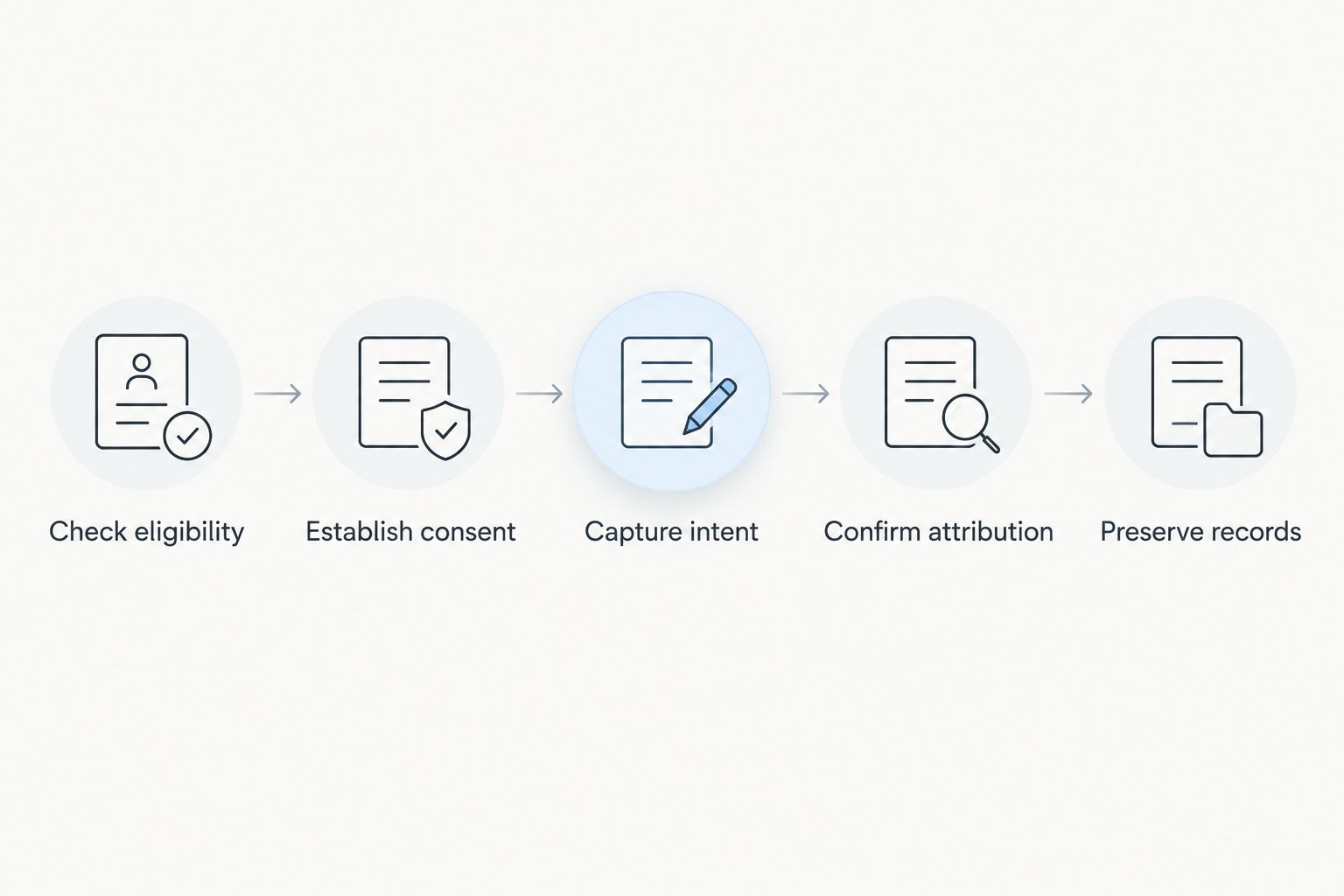
A dispute can concern any of these steps. For example, proof that someone accessed a document does not, by itself, establish that the person accepted its terms.
Which electronic signing method should you use?
U.S. law generally focuses on intent, association with the record, and the surrounding evidence—not whether the signature resembles handwriting. A typed name, drawn signature, or cryptographic digital signature can serve different evidentiary needs.
| Signing method | Best for | Main advantage | Main limitation |
|---|---|---|---|
| Typed name or acceptance action | Routine agreements with clear acceptance language | Makes electronic acceptance straightforward | Weak identity evidence when used without supporting records |
| Drawn signature or signature image | Documents that use a visible signature field | Provides a familiar visual signing action | The image itself does not establish who applied it |
| Certificate-based digital signature | Workflows requiring cryptographic integrity checks | Supports verification of signed content and certificate information | Requires certificate validation and does not resolve every authority or consent issue |
Choose the method for the document’s requirements and the evidence you need. A handwritten-looking mark is not inherently more enforceable than a typed name, and a certificate does not make unlawful contract terms valid.
For a routine agreement, clear acceptance language and a preserved final record matter more than decorative signature styling. For documents subject to technical signing standards, follow those standards rather than substituting a simpler method.
Does a typed name count as an electronic signature?
Yes, a typed name can qualify when the person adopts it with intent to sign and it is associated with the relevant record. A name appearing in an email footer or draft is not automatically proof of assent to a contract.
Is a digital signature legally stronger than an electronic signature?
A digital signature supplies cryptographic evidence about signed content and the certificate used. That evidence serves a different purpose from proving that the signer understood the terms, had authority, and intended to enter the agreement.
Why electronic signature enforceability varies
In 2026, there is no single signature appearance that makes every document enforceable. The outcome depends on the agreement, the governing rules, and the evidence available if someone challenges it.
- Document type: Statutory exceptions and specialized procedures affect whether the general electronic-signature rules apply.
- Intent to sign: The signing action must indicate assent rather than document receipt, review, or an unrelated action.
- Consent to electronic dealings: Applicable law can require agreement to transact electronically or additional consumer disclosures.
- Identity and authority: Evidence must connect the signature to the person, and a business representative must have authority to bind the organization.
- Record integrity: The evidence should identify the terms accepted and distinguish the signed version from later edits.
- Contract validity: Ordinary defenses—including fraud, duress, and lack of capacity—remain relevant even when the signature process is sound.
A process that addresses these factors is easier to explain than a folder containing an isolated signature image. The goal is not collecting the largest possible log; it is preserving relevant evidence that explains the transaction.
What evidence should you keep with a signed document?
Keep the completed agreement together with available records showing how it was presented and accepted. The evidence should connect the signer, the acceptance action, and the exact document.
Useful records include the acceptance wording, delivery correspondence, signing timestamps, authentication records, and any completion certificate or event history the signing service actually provides. An email address or IP address contributes context; neither establishes identity conclusively on its own.
Do not assume a service captures every item. Before choosing a workflow, inspect what you can export and whether those records remain understandable outside the service.
Preserve the final version
Retain the executed document, not just an editable source file or an unsigned draft. If the parties change terms afterward, document the amendment rather than silently replacing the agreement they signed.
A PDF is a file format, not proof that its contents have remained unchanged. Use the integrity evidence available in the signing process and preserve the original signed file when cryptographic validation matters.
Preserve access and reproducibility
Under 15 U.S.C. § 7001(d), an electronic record used to satisfy a legal retention requirement must accurately reflect the information and remain accessible for later reference to entitled persons. It must also be capable of accurate reproduction for later reference.
There is no universal E-SIGN retention period for every contract. Determine the applicable period from the document’s governing legal, regulatory, and contractual requirements, then make sure your storage process supports it.
When does electronic consent need extra attention?
Agreeing to sign electronically and receiving a legally required disclosure electronically are related but distinct issues. The E-SIGN Act does not require everyone to accept electronic records or signatures.
For consumer transactions in 2026, examine 15 U.S.C. § 7001(c) when another law requires information to be provided or made available in writing. Its requirements include affirmative consent, specified disclosures, and electronic consent or confirmation that reasonably demonstrates the consumer’s ability to access the electronic form used.
The disclosures address matters such as the scope of consent, withdrawal procedures, paper-copy options, and hardware or software requirements. A signature checkbox alone does not establish compliance with every applicable disclosure requirement.
Business-to-business agreements require their own analysis. Do not copy a consumer consent process into every workflow or assume that omitting it resolves all state-law consent questions.
Which documents need special handling?
An exception to the E-SIGN Act is not the same as a nationwide ban on electronic signing. It means the Act’s general recognition rule does not settle the issue; another law or procedure controls.
Under 15 U.S.C. § 7003, specified exceptions include laws governing wills, codicils, and testamentary trusts, as well as adoption, divorce, and other family-law matters. The statute also excludes specified court documents and notices, certain utility termination notices, and particular notices involving a primary residence, insurance benefits, or product safety.
This is not an exhaustive list. Check the actual document and jurisdiction before relying on an electronic signature.
- Estate documents: Confirm local execution, witness, and notarization requirements, including any applicable electronic-will law.
- Court submissions: Follow the court’s filing and signature rules rather than treating a general signing process as sufficient.
- Property transactions: Separate agreement signing from notarization, acknowledgment, and recording requirements.
- Government forms: Follow the receiving agency’s current instructions for the exact form and submission route.
For a regulated form in 2026, the receiving authority’s instructions belong in the workflow. A document editor’s ability to place a signature does not establish that the authority accepts that signing method.
Does an electronic signature replace notarization?
No. Signing and notarization perform different functions, and an electronic signature does not remove a separate notarization requirement.
E-SIGN addresses electronic notarization in 15 U.S.C. § 7001(g), but applicable notarial law still governs the authorized person’s act and required information. Remote online notarization is a separate procedure; uploading a signature image is not a substitute.
Before signing, determine whether you need an ordinary signature, witnesses, a notarial act, or a combination. Resolve that question before circulating the document so the parties do not complete the wrong process.
Where Zendocs fits in an electronic document workflow
Zendocs is best for individuals and businesses seeking web-based PDF editing, conversion, signing, and document management. Its stated scope covers those document-processing tasks through a subscription tool.
You can use Zendocs when preparing and handling documents online. The limitation is important: the stated feature scope does not establish a particular authentication method, audit-trail format, certificate capability, or notarization service.
Before selecting any signing workflow, confirm the features your agreement requires. Document-processing convenience and legal sufficiency are separate purchasing criteria.
FAQ
Is an electronic signature legally binding in every U.S. state?
Electronic signatures have legal recognition across the United States, but enforceability depends on applicable federal and state law, the document type, and the transaction. Recognition does not eliminate special execution requirements or ordinary contract defenses.
Can I legally sign a contract by typing my name?
Yes, typing your name can constitute an electronic signature when you adopt it with intent to sign and it is associated with the agreement. Preserve evidence identifying the document and the acceptance action.
Is a picture of my signature legally binding?
A signature image can function as an electronic signature when you apply or adopt it with intent to sign the relevant document. The image alone does not prove identity, authority, or agreement to the terms.
Do electronic signatures expire?
An electronic signature does not have a universal legal expiration period. Contract deadlines, certificate validity, retention requirements, and later verification are separate issues that depend on the document and signing method.
Can someone challenge a contract signed electronically?
Yes, an electronically signed contract can be challenged on grounds such as fraud, lack of authority, duress, or disputed assent. Electronic recognition prevents rejection solely because of the format; it does not prevent substantive challenges.
Does Zendocs signing make every document enforceable?
No, Zendocs signing does not by itself establish that every document is enforceable. Check the document’s legal requirements and confirm that the chosen process provides the evidence and execution steps you need.
Do I need a notary for an electronic signature?
You need a notary only when the document or applicable law requires notarization. Electronic signing does not remove that requirement, and remote notarization must follow applicable notarial rules.
One last thing
Test your ability to prove the agreement before you send it. Export a sample completed document and its available supporting records, then check whether someone outside your organization can identify the signer, the accepted terms, and the signing action.
If that explanation depends entirely on an account screen you cannot preserve, improve the recordkeeping process. A visible signature is useful; a reproducible agreement with supporting evidence is the stronger operational goal.